



The French pension system is built on pay-as-you-go funding.
Designed after the Second World War, it rested on the economic assumptions of a different era. In the 1960s there were three working people for every pensioner.
That ratio is now 1.7. By 2030, according to France's Pensions Advisory Council, it will be one to one, and it will fall below one if the population continues to stagnate.
Successive governments have made only parametric adjustments: raising the statutory retirement age, now 64, or increasing the contributions taken from gross pay.
For context, France has 30.1 million people of working age, of whom only about 25 million are in full-time work, whether employed or self-employed. The system cannot continue on this basis; it is not sustainable.
That is why it has become necessary to prepare for retirement by building capital of your own.
The Plan d'Épargne Retraite (PER) is the dedicated vehicle for doing so.
The advantages of opening a PER:

A Société Civile de Placement Immobilier (SCPI) is a collective investment vehicle structured as an unlisted company.
The SCPI pools money from a large number of investors with the sole purpose of acquiring and managing rental property.
It buys hundreds of millions of euros of property assets: shops, offices, housing, warehouses, clinics, laboratories, shopping centres. It manages and operates those assets and pays rent to investors in proportion to the capital they have committed.
Example: for €100,000 invested in an SCPI with a 5% distribution rate, the investor receives €5,000 a year, paid either into a bank account or into an assurance-vie policy.
The advantages of investing through SCPI:
We work with around thirty SCPI vehicles, selected and monitored by the firm.
In France, estates are heavily taxed on death.
A wide range of allowances, lifetime gifts, wills, investment tax regimes and ownership structures exist to mitigate that burden. We have a wealth-engineering service dedicated to complex estates, for example where there are children from several marriages.
Without any planning at all, the state can take up to 45% from the heirs.
The older you get, the fewer the options: it is best to organise your estate before 60, and before 70 at the latest, after which the available choices narrow considerably. Do not wait, once death occurs, it is too late to act.
This is the first question to address, and the one most often avoided. The gap between your final working income and your pension is known as the replacement rate. It varies sharply by status: relatively favourable for employees on modest incomes, it deteriorates markedly for senior executives as salary rises, and becomes distinctly unfavourable for the professions and for self-employed directors, who contribute proportionately less.
This deterioration is mechanical: pension schemes cap the income they take into account. Above those ceilings no further entitlement accrues, whatever you earn. Constellation Patrimoine's first task is therefore to quantify that gap precisely from your contribution record, and then to build the supplementary income needed to maintain your standard of living.
The PER is the dedicated tool: contributions are deducted from taxable income up to an annual ceiling, producing an immediate tax saving proportionate to your marginal rate. Funds are locked until retirement, apart from early-release cases, notably the purchase of a main residence. On exit, whether as capital or as an annuity, the sums are taxed. The PER is therefore a deferral mechanism: the higher your current bracket and the lower your bracket in retirement, the more effective it is.
Less targeted than the PER but far more flexible, assurance-vie remains the foundation of any plan. The capital stays available at any time, the tax on gains falls appreciably after eight years, and the policy allows scheduled withdrawals to create a regular supplementary income. It is also the most effective vehicle for passing on wealth, which gives it a dual purpose.
A property financed by a loan during your working life becomes, once the loan is repaid, a source of income that takes over from your pension. Furnished letting is particularly well suited here: depreciation allows rent to be received with little tax, precisely when your pension is already adding to your taxable income. See our page on property investment.
If your company has one, or if you are a director and can set one up, employee savings are the most efficient way to fund your retirement, thanks to the employer's matching contribution and a far more favourable tax treatment than an ordinary bonus. See our page on employee savings schemes.
As early as possible, because the levers available narrow as the date approaches.
| Age | Priority | Main lever |
|---|---|---|
| 30 to 40 | Build capital using the leverage of borrowing | Property on credit, assurance-vie with a growth profile |
| 40 to 50 | Step up saving during peak earning years | PER for the tax deduction, portfolio diversification |
| 50 to 60 | De-risk gradually and quantify the income gap | Retirement review, progressive de-risking of the portfolio |
| 60 and over | Organise income and prepare the transfer of wealth | Scheduled withdrawals, reallocation, lifetime gifts |
This is the most common blind spot, and the most expensive. A self-employed director contributes little towards a pension and often ends up with entitlements far below their standard of living. More seriously, their protection against life's accidents is frequently inadequate: a prolonged absence, a disability or a death can put both the family and the business in difficulty.
We audit the cover in place, measure the real gap between your current income and what you would receive if you stopped working, then build the missing layer: protection suited to your status, supplementary pension provision, dedicated savings. These choices cannot be separated from how you draw your income, the balance between salary and dividends, covered on our page on corporate tax optimisation.
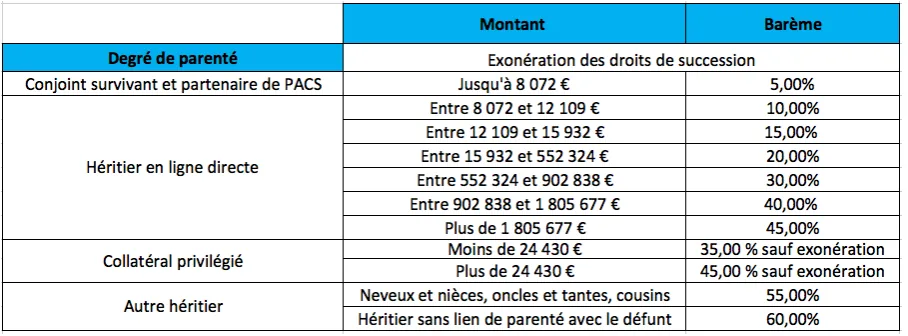
Inheritance tax is calculated after an allowance that depends on the family relationship, then on a progressive scale. The differences are considerable: transfers between spouses or PACS partners are exempt, transfers to a child benefit from a substantial allowance renewable every fifteen years, while transfers to a nephew, an unmarried partner or a third party are taxed very heavily.
It is this progressivity that makes planning decisive: the same assets passed on without preparation, or under arrangements made fifteen years earlier, carry an entirely different tax burden.
This is the most effective vehicle in French law for transferring wealth. Capital paid to the beneficiaries named in the policy falls outside the ordinary rules of succession and is taxed under a specific regime, markedly more favourable for premiums paid before the policyholder turns 70. Drafting the beneficiary clause is a technical exercise, and one we handle as a matter of course.
Giving during your lifetime lets you use the allowances, which are renewed every fifteen years. A transfer organised in several successive waves sharply reduces, and can eliminate, the duties payable on death. Gifts may consist of cash, securities or property.
Giving away the bare ownership while retaining the usufruct allows an asset to be transferred at a reduced value, only the bare ownership is taxed, while you continue to receive the income and occupy the property. On death the usufruct is extinguished and the bare owner becomes full owner with no further duties to pay.
A société civile immobilière makes it easier to pass on a property portfolio progressively by gifting shares, while allowing the donor to remain manager and therefore keep control of decisions. It also avoids the deadlocks of joint ownership between heirs.
Family succession, a sale or a merger: for most directors this is the largest asset they own, and the one whose transfer is least often planned. Relief schemes allow the taxable base to be reduced very substantially on a family transfer, subject to undertakings to retain the shares and continue the business.
On a sale the issue shifts: the central question becomes the reinvestment of the proceeds, with deferral mechanisms that must be structured before signing. Many directors raise the subject once the deal is done, by which time the levers are no longer available. See our page on corporate services.
We carry out a full audit of your family and financial position: contribution record, matrimonial regime, composition and ownership of assets, and your objectives for passing on wealth. We then present a costed strategy, the income gap at retirement, the tax cost of your estate as it currently stands, and the effect of each lever considered, set out in a written report. We handle implementation in coordination with your notaire and your accountant, then monitor progress with a quarterly review, because these strategies unfold over several years.
Entry level. Retirement and estate advice carries no threshold at all: the retirement review, the protection audit and the organisation of your estate are available whatever the size of your wealth. For managed financial investments in France, PER, assurance-vie and retirement savings contracts, we work from €20,000. Premium wrappers keep their own entry levels: €250,000 for Luxembourg assurance-vie and €300,000 for a Swiss bank account.
Written by Mevlana Yildirim, founder of Constellation Patrimoine, a French Financial Investment Adviser (Conseiller en Investissements Financiers), registered with ORIAS under no. 26006339. Offices at 11 Avenue de Friedland, 75008 Paris, and through Mevlana Investments LLC in Dubai, first discovery meeting free of charge. General information for guidance only; this does not constitute personalised advice.
Ideally between 35 and 40, because the most powerful levers need time: the leverage of a property loan requires both borrowing capacity and a long enough term, and compounding delivers most of its effect over decades. After 55 it is still possible to act, but the options narrow largely to the level of saving and to tax optimisation.
Clearly so from the 30% marginal bracket upwards, and fully so at 41% or 45%, because the tax saving on the way in is proportionate to that bracket. It is far less compelling below: capital is locked until retirement for a limited benefit. The PER defers tax rather than cancelling it, so its value rests on the gap between your bracket today and your bracket in retirement.
The allowances that apply to lifetime gifts are renewed every fifteen years. Organising transfers in successive waves therefore allows substantial wealth to pass on while sharply reducing, or even eliminating, the duties payable on death. Giving early also transfers assets before they appreciate, since tax is charged on the value at the date of the gift.
Because the capital paid to the beneficiaries named in the policy falls outside the ordinary rules of succession and is taxed under a specific regime, which is particularly favourable for premiums paid before the policyholder turns 70. It also allows beneficiaries to be chosen freely, including outside the family, and the capital to be split in whatever proportions you wish.
Rarely, under self-employed status. The benefits paid by the compulsory scheme are generally far below the director's standard of living, and sometimes non-existent during a waiting period. An insurance audit measures the real gap between your current income and what you would receive if you stopped working, so that it can be closed.
By planning several years ahead. Relief schemes allow the taxable base to be reduced very substantially, subject to undertakings to retain the shares and continue the business. Combined with a gift of bare ownership and a suitable governance structure, they make it possible to hand over the company without endangering its cash position or its continuity.
For financial investments in France, PER, assurance-vie and retirement savings contracts, we work from €20,000. There is, however, no threshold for retirement and estate advice itself : the retirement review, the protection audit and the organisation of your estate are available whatever the size of your wealth. Premium wrappers keep their own entry levels : €250,000 for Luxembourg assurance-vie and €300,000 for a Swiss bank account.

An exploratory meeting to assess your financial situation and see how we can help, at no cost and with no obligation.
01Together we set out the terms of our partnership and put forward tailored solutions suited to your circumstances.
02Access carefully selected investment opportunities and grow your wealth towards your objectives, with support at every step.
03

