



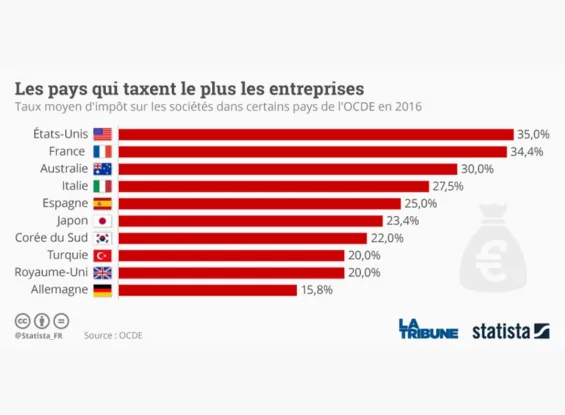
France is a punishing environment for business taxation. Whatever your legal form, SAS, SARL, SA, sole trader or auto-entrepreneur, you pay at least 40% of your net profit to the state.
As a sole trader:
Auto-entrepreneurs pay a flat social-security charge of 22% on top of income tax. The position is similar for a sole proprietorship: monthly social-security, pension and health contributions, plus income tax. Depending on turnover, the effective rate lands between 40% and 70%.
Through a company:
Taking income out of your company is expensive. In an SAS the total charge reaches 70%; in an SARL around 40%. That is before income tax, which comes on top of corporation tax (charged in two bands, 15% and 25%).

There are better options than working half the year for the state.
We start by examining the legal structure, and the director's status in particular, before putting forward proposals for optimisation and investment. We work with business owners from €100,000 of annual turnover upwards, whether they operate alone or with employees.
What we handle:
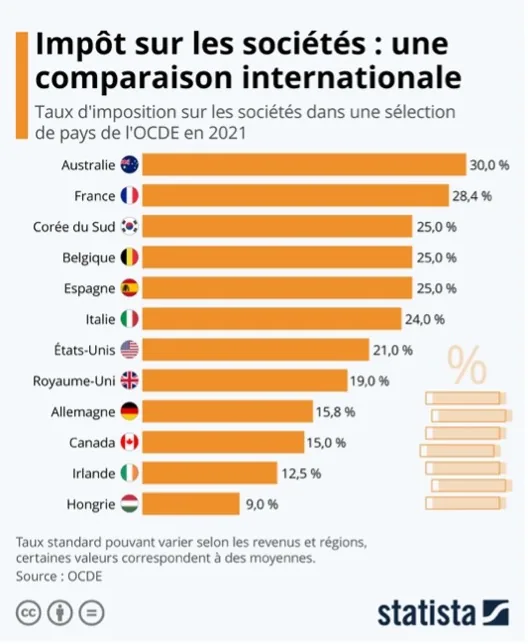
Taxes on production and the overall burden on French businesses are among the heaviest in the world. The question is not whether you pay tax, but whether the structure you pay it through is the right one.

A business wealth audit is a complete diagnosis of the financial position of the company and of its director, resulting in a written report of costed recommendations. It is neither an accounting audit (which checks that the accounts are correct) nor a statutory audit. The purpose is different: to identify what, in the current arrangements, is costing money unnecessarily or exposing the business and its owner to avoidable risk.
Constellation Patrimoine examines both sides at once, the corporate and the personal, because decisions taken inside the company directly determine the director's private position.
Four situations account for most requests. The first is surplus cash sitting idle: substantial sums left in a current account lose value mechanically every year. The second is taxation simply endured: the director sees the tax bill without ever having compared the possible remuneration scenarios.
The third is a poorly protected director, the discovery, often late, that cover in the event of sick leave falls far short of their standard of living. The fourth is a planned sale or handover: here anticipation determines everything, because the most effective levers must be in place several years before the transaction.
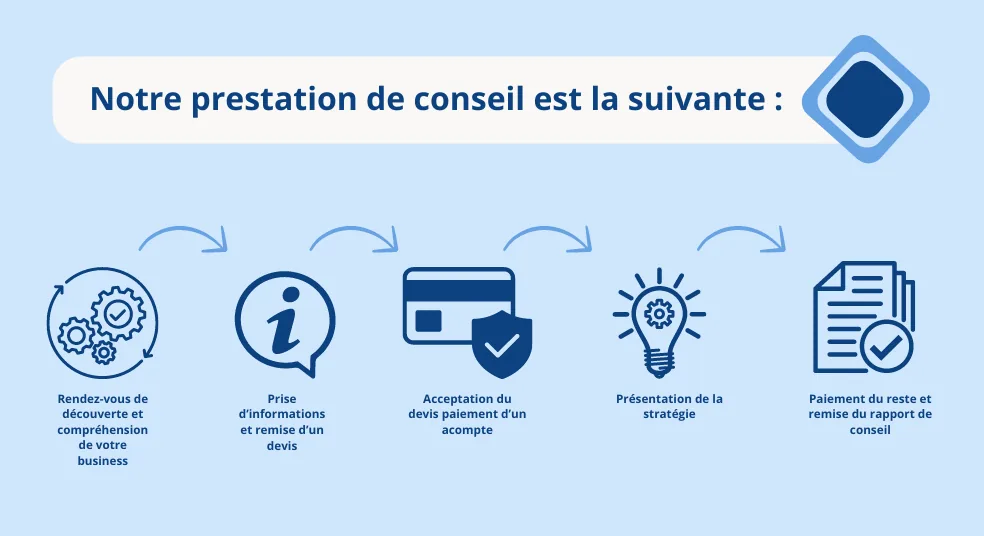
We gather what is needed, tax returns for recent years, articles of association, existing protection and pension contracts, the director's contribution record, and hold a detailed discussion to understand your personal and business objectives. Getting this understanding right determines how useful everything that follows will be.
You receive a written document setting out, for each area examined, the current position, the options available and their quantified impact: expected saving, cost of implementation, effect on cash and on your private wealth. We always present several scenarios rather than a single solution.
We put the chosen solutions in place in coordination with your existing advisers, accountant, lawyer, notaire, and then provide structured monitoring with a quarterly review, because some strategies only deliver their full effect over time.
The first discovery meeting is free and carries no obligation. It allows us to frame your requirements, estimate the work involved and establish whether our involvement is genuinely relevant to you. The terms of engagement, and all fees, are set out at that point, transparently. It is one of the firm's three founding principles, alongside clarity and rigour.
Constellation Patrimoine manages more than €10 million in assets and draws on 7 years of experience, from its offices at 11 Avenue de Friedland in Paris and through Mevlana Investments LLC in Dubai.
Written by Mevlana Yildirim, founder of Constellation Patrimoine, a French Financial Investment Adviser (Conseiller en Investissements Financiers), registered with ORIAS under no. 26006339. Offices at 11 Avenue de Friedland, 75008 Paris, and through Mevlana Investments LLC in Dubai, first discovery meeting free of charge. General information for guidance only; this does not constitute personalised advice.
The free first meeting lasts about an hour and is used to define the scope. The audit itself depends on how complex your structure is : the number of companies, whether a holding company exists, property held by the business. It results in a written report, presented and discussed with you, with no obligation to go further.
Tax returns for the last two or three financial years, the company's articles of association, your existing protection and pension contracts, your contribution record and, where relevant, the deeds relating to property you own. We send you a precise list before the meeting so that the session is productive from the outset.
Yes. It is not the size of the business that makes an audit worthwhile but the situation: idle cash, taxation simply accepted rather than planned, a director who is poorly protected, or a sale being considered all justify a diagnosis, including for a sole trader or a very small company.
Yes, the roles are complementary rather than competing. Your accountant produces and secures the accounts; we work on the wealth strategy of the business and its director: investing surplus cash, the balance of pay and dividends, personal protection, employee savings and succession. We always coordinate with them.
No. The recommendations report is yours and you remain free to decide what follows. If you choose to implement some or all of the proposals, we support you through the rollout and then monitor progress with a quarterly review.

An exploratory meeting to assess your financial situation and see how we can help, at no cost and with no obligation.
01Together we set out the terms of our partnership and put forward tailored solutions suited to your circumstances.
02Access carefully selected investment opportunities and grow your wealth towards your objectives, with support at every step.
03

