
Real Estate is one of people’s favourite investment in the world. Secure, profitable and tangible, property is also the subject of much speculation. Investing in property should always be considered with the help of a specialist. This type of investment is more complex than it appears
1) Define your project and your objectives
It's important to discuss your plans. Investing in property is not a trivial matter. Choosing your principal residence is a completely different matter from investing in rental property.
You can invest in property
to reduce tax, prepare for retirement, earn extra income or find the home of your dreams.
2) Choosing the right location. Location location location?
Location is an important criterion, but it's not the only one, especially for rental investment.
It's better to invest far from home but with an attractive return than next door with a low return.
3) Entrust your advisor with the property search
Mevlana will find for the best flat or house for your project.
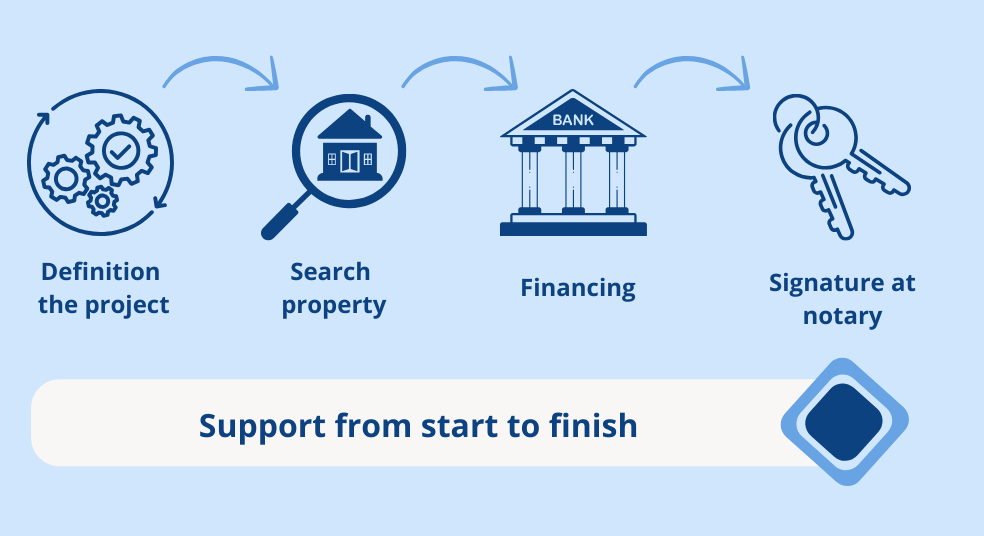
4)Financing your project
We work with many banks and loan brokers in France and abroad.
If the project can be financed, we have a 100% success rate in financingour customers' projects.
5) Have the notary certify the transaction
Please note! Tax is always a consideration when planning a property purchase.
All property is subject to property tax based on local rates. In the case of rental investments, except for LMNP, rental income is subject to property tax.
Mevlana, your personal consultant, is a holder of authorizations to do Real Estate everywhere in the world.
He can advise you on all types of new and existing properties directly throughout UAE, France, Germany, Indian Ocean, Mauritius, Singapore and in countries where he has a partnership agreement.
Dubai is one of the fastest-growing regions in the world, with economic growth forecast to reach 8% by 2023. A veritable hub between the Middle East, Asia and Europe, Dubai is constantly expanding.
The advantages of investing in Dubai:

Yes. France places no restriction on property ownership by foreign nationals or non-residents. You do not need to hold French residency, a French passport or a French bank account to buy — although a French account makes the process considerably smoother in practice.
The purchase follows the same legal route as for a French resident: a preliminary contract, a statutory cooling-off period, then the deed of sale executed before a notaire, the public officer who secures the transaction and collects the associated taxes. Constellation Patrimoine coordinates the process from Paris, alongside our international office in Dubai.
Yes, and this is often the decisive point. French banks do lend to non-residents, generally on stricter terms than for residents: a larger deposit is expected, and lenders pay close attention to the stability and the currency of your income. Borrowing in euros while earning in another currency introduces exchange-rate risk that lenders assess carefully.
Financing deserves as much attention as the property itself. Interest rate, borrower's insurance, term and repayment structure affect net return over the entire life of the loan — often more than negotiating the purchase price. Constellation Patrimoine acts as a credit intermediary: we assess your real borrowing capacity, prepare the file, put lenders in competition and negotiate terms.
Buying a property let unfurnished. Rental income falls under revenus fonciers, taxed on a net basis after deductible expenses. Renovation works can generate a deficit that reduces the taxable base. This route suits investors willing to undertake works and manage the asset.
Furnished rental income is taxed as business income rather than property income. Under the actual-expenses regime, you may deduct costs and — crucially — depreciate the property. That depreciation offsets much of the taxable result, allowing rental income to be received with little or no tax for many years. It is usually the most efficient route for a net income stream.
An SCPI holds a diversified portfolio of offices, retail, healthcare and logistics assets and distributes rental income in proportion to your units. There is no management to handle, the entry ticket is modest and tenant risk is spread across dozens of buildings. It is the simplest way to gain exposure to French real estate from abroad.
The société civile immobilière is a structuring tool rather than a tax scheme. It facilitates joint ownership, allows gradual transfer through gifts of shares, and — where it opts for corporate taxation — permits depreciation of the property. That election is effectively irreversible and materially changes the tax treatment on sale: it should follow a simulation, never a default preference.
| Route | Entry ticket | Management | Liquidity | Best suited to |
|---|---|---|---|---|
| Direct unfurnished | High | Heavy | Low | Projects involving renovation |
| Furnished (LMNP) | High | Moderate | Low | Tax-efficient income |
| SCPI | Low | None | Moderate | Exposure from abroad |
| SCI | Variable | Variable | Low | Joint ownership, succession planning |
Three layers apply and must be anticipated together. Rental income is taxable in France regardless of where you live, since France taxes income arising from French real estate. Wealth tax on real estate applies to French property assets above a statutory threshold, and non-residents are assessed on their French assets only. Capital gains on disposal are taxed in France, with an allowance that increases with the holding period until full exemption after a long period of ownership.
Crucially, a double taxation treaty between France and your country of residence determines how tax paid in France is credited at home. The exact outcome therefore depends on where you are resident: this is analysed case by case before any acquisition.
We start with a full audit: borrowing capacity, tax residency, existing assets, horizon and objectives — income, capital growth or succession planning. We then present costed options, showing net return after tax, real monthly cash-flow effort and projected value, set out in a written recommendation report. We handle implementation — financing, tax regime, ownership structure — then ongoing monitoring with a quarterly review.
Constellation Patrimoine operates from Paris, with an international office in Dubai (Mevlana Investments LLC) and strategic partners in Luxembourg, Switzerland and the United States. The first consultation is free of charge.
Written by Mevlana Yildirim, founder of Constellation Patrimoine, Financial Investment Advisor (CIF), registered with ORIAS under no. 101280329. Offices at 11 Avenue de Friedland, 75008 Paris, and an international office in Dubai (Mevlana Investments LLC). First consultation free of charge. General information only — this does not constitute personalised advice.
Yes. France imposes no restriction on property purchases by foreign nationals or non-residents. You do not need French residency or citizenship. The transaction follows the standard route: preliminary contract, statutory cooling-off period, then the deed executed before a notaire, who secures the sale and collects the related taxes.
Yes. French banks lend to non-residents, though generally on stricter terms than to residents: a larger deposit is expected and lenders examine the stability and currency of your income closely. Borrowing in euros while earning in another currency creates exchange-rate exposure that lenders price in. We assess your borrowing capacity and negotiate terms on your behalf.
Rental income from French property is taxable in France whatever your country of residence, because France taxes income arising from French real estate. The applicable regime differs between unfurnished letting and furnished letting, the latter allowing depreciation of the property. A double taxation treaty then governs how the French tax is credited in your home country.
An SCI is a French civil property company used to hold real estate. It makes joint ownership easier, allows gradual transfer through gifts of shares and, if it elects for corporate taxation, permits depreciation of the property. That election is effectively irreversible and significantly increases tax on the eventual capital gain, so it should always follow a costed simulation.
Yes. We assess borrowing capacity, arrange and negotiate financing as a credit intermediary, advise on the ownership structure and the applicable tax regime, and coordinate with the notaire through to completion. We then provide ongoing monitoring, with a quarterly review.
Take advantage of an initial exploratory interview to assess your financial needs and find out how we can help you.
01Let's work together to establish the terms of our partnership, proposing personalised solutions tailored to your financial situation.
02Dive into exciting investment opportunities and grow your money to achieve your financial goals with confidence and success.
03